
Managing Dentist Anxiety in Children: A Guide for Parents
22 May 2026
If your child gets anxious about the dentist, they are not being dramatic and they are not alone in it. Dental anxiety in children is one of the most common challenges pediatric dentists see, and it responds well to the right preparation at home and the right approach in the chair.
The part that frustrates most parents is feeling stuck between two bad options. You do not want to force your child into something that scares them, but you also cannot keep postponing care. That tension usually comes from not knowing what you can do at home to help, and not knowing what tools the dentist has that you have never seen in action.
At Kids Dental Group, our pediatric specialists work with anxious children every day. The team, along with Iris the facility dog, is trained to help even the most resistant kids feel safe enough to sit in the chair.
How to Tell If Your Child Has Dental Anxiety
Dental anxiety does not always look like a meltdown in the waiting room. Sometimes it is much quieter, and recognizing it early gives you more time to prepare.
Signs and Behaviours to Watch For
Watch for increased clinginess on the morning of the appointment, complaints of stomach aches or headaches that appear conveniently before the visit, trouble sleeping the night before, or going unusually quiet when you mention the dentist. Some children ask the same question over and over (“Will it hurt? Will they use a needle?”) as a way of managing their worry. In younger children, you may see regression behaviours like thumb sucking, wanting to be carried, or refusing to get in the car.
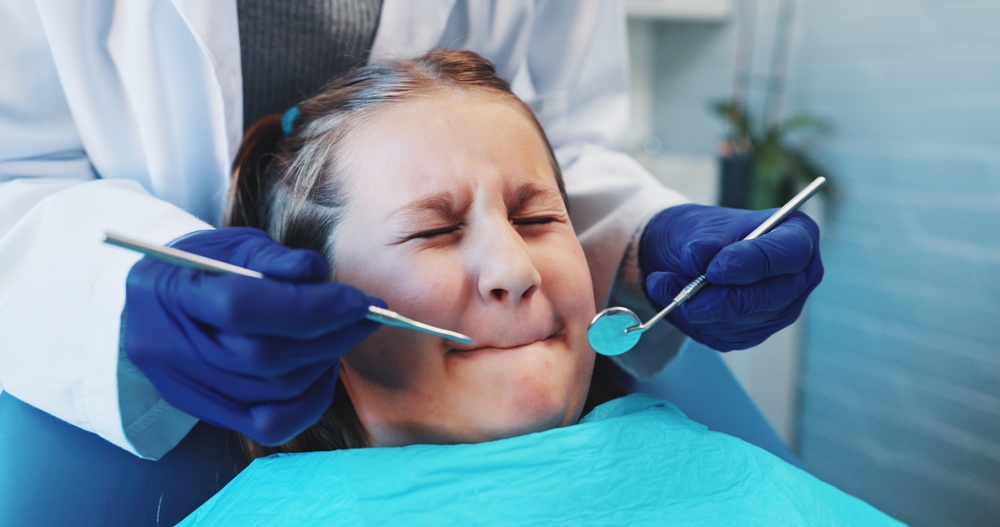
During the appointment itself, anxiety can show up as a rigid body, clenched fists, turning the head away, or crying that starts before the dentist has touched anything. A child who cooperates but is stiff and silent the entire time is also anxious. They are managing it internally instead of externally, and they still need support.
Why Children Develop Dental Anxiety
Most dental anxiety in children traces back to one of four sources: a previous negative experience where they felt pain or felt out of control, fear of the unknown because they have never been to a dentist and do not know what to expect, absorbing a parent or sibling’s negative attitude about the dentist, or sensory sensitivity where the sounds, lights, smells, or physical sensations of the office feel overwhelming.
Identifying which source is driving your child’s anxiety helps you and the dentist respond to it accurately. A child afraid of the unknown needs information and familiarity. A child who had a painful experience needs trust rebuilt slowly. A child with sensory sensitivity needs the environment adjusted. Each one calls for a different approach at home and in the chair.
What Parents Should (and Should Not) Say Before a Visit
Keep your language simple and matter-of-fact. “The dentist is going to count your teeth and check that everything looks healthy” is enough for a young child. If they ask whether it will hurt, a good answer is “The dentist will be very gentle and will tell you everything before it happens.” That is honest without being a blanket promise.
Avoid using the dentist as a threat. “If you do not brush, the dentist will have to drill your teeth” creates a fear association that can take years to undo. Avoid over-preparing with details about tools, needles, or procedures. Children are imaginative, and giving them too much information about things they were never going to think about can create new worries. Avoid saying “it will not hurt” as a guarantee. If something does cause discomfort, you have broken their trust, and trust is the thing that makes the next visit easier.
How to Prepare Your Child for a Dental Appointment
Using Books, Videos, and Play to Build Familiarity
For a first visit, read a picture book about going to the dentist or watch a short video showing a child having a calm, positive dental experience. Play dentist at home by letting your child look in your mouth with a flashlight, count your teeth, and then switch roles. This transfers some control to them before they walk into the office, which reduces the feeling of being at someone else’s mercy.
For a child who has had a negative experience, the goal shifts from information to reassociation. Talk about the new dentist as a different team in a different place. Let your child know the dentist will go at their pace, that they can raise a hand to pause at any time, and that the first visit may just be sitting in the chair and looking around. Removing the pressure to “get through” the appointment changes how they walk in.
How Dentists Help Reduce Anxiety During Visits
The Tell-Show-Do Approach Explained
Pediatric dentists use a technique called Tell-Show-Do. Before doing anything, they tell the child what is about to happen using simple, non-clinical language. Then they show the child the tool or demonstrate on a finger, a stuffed animal, or the parent’s hand. Then they do it. The entire sequence is designed to remove surprise, which is the single biggest trigger for anxiety in the chair.
Using Child-Friendly Language and Positive Reinforcement
Pediatric dental teams replace clinical words with ones that feel less threatening. The suction tool becomes “Mr. Thirsty.” The dental explorer becomes “the tooth counter.” The X-ray machine takes “a picture of your teeth.” This is not about being cute. It is about removing the vocabulary that triggers fear responses in children who associate medical language with pain.
Praise is specific and immediate. “You did a great job keeping your mouth open for that” works better than a generic “good job” at the end, because it tells the child exactly what they did well and reinforces the behaviour in the moment.
Sedation Options for Children Based on Anxiety Level
When behavioural techniques are not enough on their own, sedation provides an additional layer of support. Your dentist will recommend a level based on your child’s anxiety, the treatment needed, and their age and medical history.
Nitrous Oxide (Laughing Gas)
A mild sedative inhaled through a small mask placed over the nose. Your child stays awake and can talk and respond, but feels relaxed and less aware of discomfort. It wears off within minutes after the mask is removed. No lasting grogginess, no recovery time. This is the most commonly used sedation option for children with mild to moderate anxiety.
Oral Sedation
A liquid medication given before the appointment that makes the child drowsy and calm. They remain conscious but are significantly more relaxed and may not remember the visit afterward. This is used for children with moderate anxiety, for longer procedures, or for children who need more support than nitrous alone provides.
General Anaesthesia
The child is fully asleep throughout the procedure. This is reserved for children with severe anxiety that has not responded to other methods, very young children who cannot cooperate for treatment they urgently need, or situations where multiple procedures need to be completed in a single visit. A medical anaesthesiologist administers and monitors the sedation, either in the dental office or at a hospital.
The Role of Frequent Visits in Reducing Anxiety Over Time
The most effective long-term strategy for reducing dental anxiety is consistent, routine visits. A child who comes every six months sees the same team, sits in the same chair, hears the same sounds, and has experiences that are predictable. Each visit that goes well weakens the fear association and builds trust that carries into the next one.
Skipping visits because your child is anxious feels protective, but it works against you. The longer the gap between appointments, the more unfamiliar the experience becomes. And the more likely it is that treatment will actually be needed when they do return, which reinforces the belief that the dentist equals discomfort. Keeping the schedule consistent, even when your child resists, is one of the most important things you can do.
How Pediatric Dentists Adapt Care for Anxious Children
Pediatric dentists complete two to three years of additional training beyond dental school that includes child psychology, behaviour guidance, and techniques for working with children who are afraid, uncooperative, or have developmental conditions that affect how they experience dental care. This goes well beyond being friendly or patient. It includes reading body language, adjusting the speed and sequence of the appointment, offering breaks, using distraction (ceiling-mounted screens, music, toys, conversation), and knowing when to gently persist and when to stop and try again next time.
Building trust over multiple visits is part of the treatment plan. A first visit where all the child does is sit in the chair and go home with a sticker is not a failed appointment. It is the foundation for the appointment after that.
When Dental Anxiety Becomes Severe
If your child’s anxiety consistently prevents them from receiving care despite behavioural techniques and mild sedation, talk to your pediatric dentist about a phased approach. This might start with a “happy visit” where no treatment happens at all. The child meets the team, explores the office, sits in the chair, and leaves on a positive note. Over several visits, the dental team introduces one new element at a time, building tolerance gradually.
For children whose anxiety is tied to sensory processing differences, autism spectrum conditions, or other developmental factors, pediatric dentists can create individualized plans. These may include shorter appointments, reduced sensory input (dimmed lights, quieter instruments, weighted blankets), or scheduling at low-traffic times when the office is calmer.
Your Next Step
If your child is anxious about the dentist, the right team can change how they feel about dental care for years to come. One visit focused on trust and comfort can set a new baseline for every visit that follows.
At Kids Dental Group, our pediatric specialists are trained to work with anxious children at every level. Iris, our facility dog, is there to help kids feel calm before they even sit in the chair. Book a visit and let us show your child that the dentist can be a place where they feel safe.
Book Your Appointment Today