

Baby Teeth Chart: Teeth & Development Milestones
03 Sep 2026
Medically reviewed by Dr. Edina Heder at Kids Dental Group
Most parents use a baby teeth chart to answer one question: When should the next tooth appear? But the timing is only part of the story.
Every new tooth marks a developmental milestone. As teeth come in, they help your child learn to chew new foods, form certain speech sounds, support healthy jaw growth, and hold space for permanent teeth. Read this way, a baby teeth chart becomes more than a timeline, it becomes a map of your child’s development.
This guide explains what each stage tells you, what’s considered normal, and when it’s worth checking in with a pediatric dentist.
Key takeaways
- The order of baby teeth is usually predictable, but healthy variation is common. Focus on steady overall progress instead of exact timing.
- Baby teeth support speech development. Front teeth help children form certain sounds, although speech depends on much more than teeth alone.
- Baby teeth make chewing and eating easier as new textures are introduced. Different teeth help your child progress from soft foods to more challenging textures.
- Baby teeth guide jaw growth and permanent teeth. They support healthy facial development and hold space for the adult teeth developing underneath.
- Knowing what’s normal helps you know when to book a dental visit. Most differences are harmless, but a few signs are worth having checked by a pediatric dentist.
Throughout this guide we’ll connect teeth to four things you can actually watch: how your child talks, how they eat, how their jaw and face grow, and how baby teeth set up the permanent set to come. If you want exact ages, keep a detailed month-by-month timeline handy as a reference alongside this one. See our month-by-month baby teeth timeline for the specifics.
What is the typical order, and why might your child not follow it?
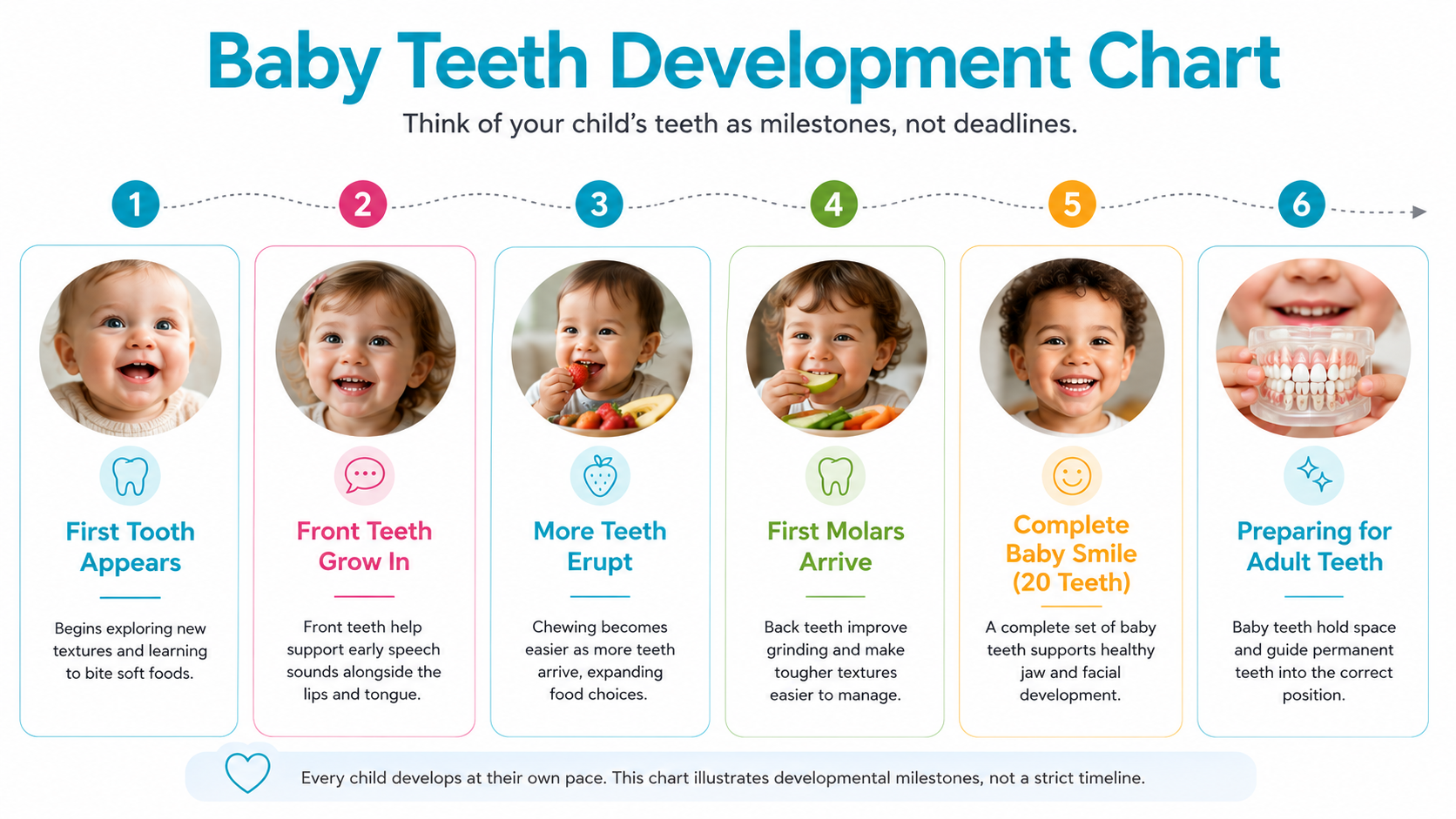
The typical order is lower central incisors (the two bottom front teeth) first, usually around 6 to 10 months, followed by the upper front teeth, and the other incisors, then the first molars, canines, and second molars over the next two years or so. Many healthy children vary from this exact sequence, and that variation alone is rarely a concern.
Why does sequence differ from child to child? A few plain reasons:
- Family patterns. If you or a sibling got teeth in a slightly different order or later than average, your child may follow suit.
- Normal individual differences. Development runs on its own clock for every child.
- Timing overlap. Several teeth are working toward the surface at once, so which one breaks through first can be close to a coin toss.
Here’s a scenario parents worry about often: an upper tooth appears before its matching lower one, or the two upper front teeth come in with a gap between them.
Out of sequence, sure.
A problem, usually not.
What matters more than any single tooth is the overall progression over months, whether teeth keep arriving and your child keeps developing alongside them. A gap between the upper front teeth in particular often closes on its own as more teeth come in.
Do baby teeth affect your child’s speech?
Yes, baby teeth help your child form certain sounds, but they are one piece of a larger system. The front teeth support sounds like “f,” “v,” “th,” and “s” as your child moves from babbling to real words. A single missing or late tooth rarely causes lasting speech issues, because speech also depends on the tongue, lips, and hearing.
As your child’s front teeth come in, you may notice sounds sharpen. That’s the tongue and lips learning to work against a new surface. It’s a gradual process, and children adapt quickly.
Because speech relies on so much more than teeth, a gap where a tooth hasn’t arrived yet, or one that came in a little late, usually isn’t the cause of a speech delay on its own. Where teeth and speech can intersect is with persistent habits. Prolonged thumb-sucking or extended pacifier use can, over time, shift the position of the front teeth, and that shift can occasionally affect how certain sounds are made. This isn’t cause for alarm, and habits in the early years are very normal, but it’s worth keeping an eye on as your child grows.
If speech concerns persist, the right step is a professional assessment rather than guessing at the cause. A pediatric team can look at tooth position, and a speech-language professional can look at the sounds themselves, so you get clarity instead of worry.

From purees to real food: how do teeth support chewing?
Teeth expand what your child can eat, but chewing starts before teeth do. Newborn gums and, later, the front teeth handle the earliest work of managing soft solids. The back molars, which usually arrive later in toddlerhood, are what unlock chewier, more complex textures like meats and raw vegetables.
This surprises many parents: your child can begin soft solids before molars ever appear. Gums do a surprising amount of early mashing, and the front teeth help with biting off pieces. That’s why purees and soft, dissolvable foods work well in the months when only a few front teeth are in.
As the first molars come in, usually somewhere in the second year, your child gains grinding surfaces at the back. That’s when tougher, chewier textures become more manageable and safer to handle. You’ll often notice your toddler start to enjoy foods they couldn’t cope with before.
One practical note: teeth guide the solids transition, but they don’t dictate it. Follow your child’s readiness cues, sitting up well, showing interest in food, managing textures without gagging, alongside guidance from your pediatrician or a feeding professional. Teeth are one signal among several, not a checklist item to wait on.
What role do baby teeth play in jaw growth and permanent teeth?
Baby teeth act as placeholders. Each one holds space in the jaw and helps guide the permanent tooth beneath it into the right position. This is called their space maintainer role: the baby tooth keeps its spot open until the adult tooth is ready to take over.
A full set of baby teeth also supports healthy jaw and facial growth. Regular chewing across a complete set of teeth encourages the jaw to develop and helps the arches form with room for the teeth to come. Teeth and jaw growth work together during these years.
This is why early loss of a baby tooth matters more than it might seem. If a baby tooth is lost too soon, from decay or an injury, the neighbouring teeth can drift into the empty space. That can crowd the spot the permanent tooth was meant to fill. In these cases, our pediatric specialists sometimes recommend a space maintainer, a small appliance that holds the gap open until the adult tooth is ready.
How the baby teeth guide the permanent set also sets the stage for later orthodontic care. Watching spacing and growth early means that if your child eventually needs braces or Invisalign, the timing and plan can be considered thoughtfully rather than as a surprise. Our team can flag this during routine visits, with no pressure and no promises about outcomes, just a clear picture of what’s developing. Learn more about early orthodontic evaluations if you’re curious about that stage.
Curious whether your child’s development is on track? Schedule a gentle, stress-free consultation. Book online or call any of our four GTA locations.
What’s normal, what’s worth watching, and when should you book?
Wide variation in timing and order is normal. Every child develops on their own clock, and most differences you notice, a later start, an out-of-order tooth, a small gap, resolve on their own. That said, a few calm, concrete signs are worth a professional look rather than a wait.
Consider booking a visit if you notice:
- No teeth at all by a notably late age, well past the usual upper end of the range.
- Significant asymmetry, where one side of the mouth is developing quite differently from the other.
- Teeth that seem to affect eating or cause ongoing discomfort.
- Early tooth loss from decay or injury, which can affect spacing for the adult tooth underneath.
The first dental visit is a milestone in its own right. A good guideline is by the first tooth or the first birthday, whichever comes first. This early visit is less about fixing anything and more about comfort, prevention, and helping your child feel at ease in the chair.
Whatever brings you in, the goal is a gentle, stress-free assessment. Our pediatric specialists explain what they see in plain language, and if any next steps are needed, we’ll walk you through the process and discuss any costs before treatment, so nothing comes as a surprise. Explore our pediatric dentistry care to see how first visits work.
Frequently asked questions
Is it a problem if my baby’s teeth come in out of order?
Usually not. The typical order (lower front teeth first) is common, but plenty of healthy children vary from it. Sequence differences on their own rarely signal a problem. What matters more is steady progress over time. If you’re unsure, a pediatric dentist can reassure you at a routine visit.
Do baby teeth affect my child’s speech?
Baby teeth, especially the front ones, help your child form certain sounds like “f,” “v,” “s,” and “th.” That said, speech depends on the tongue, lips, and hearing too, so a single missing or late tooth rarely causes lasting speech issues. If speech concerns continue as your child grows, ask a professional for an assessment.
When should my child have their first dental visit?
A good guideline is by the time the first tooth appears or around your child’s first birthday, whichever comes first. This early visit is more about comfort, prevention, and getting your child used to the chair than fixing problems, and it’s a milestone worth marking.
Why do baby teeth matter if they fall out anyway?
Baby teeth do real work while they’re here. They help your child chew and eat a range of textures, support speech, and hold space so permanent teeth can come in properly. Losing a baby tooth too early, from decay or injury, can affect the spacing for the adult tooth underneath.
My child got teeth later than other kids. Should I worry?
Later timing is often just normal variation, and it can run in families. A single late tooth or a slower overall start usually isn’t a concern by itself. If your child reaches a notably late age with no teeth at all, it’s worth a gentle check-in with a pediatric dentist for peace of mind.