
Shark Teeth in Kids: Why Adult Teeth Grow Behind Baby Teeth
09 Sep 2026
Medically reviewed by Dr. Zee Wang at Kids Dental Group
Your child opens wide to show you a wiggly tooth, and there behind it is a second tooth, already poking through the gum. For a second your stomach drops. Two rows of teeth. That is not what you expected.
You are not overreacting for looking this up. It looks alarming, and most parents have the same first thought: is something wrong with the way my child’s teeth are coming in? The short version is that this is common, it has a name – “shark teeth” – and in most cases it sorts itself out. Below we walk through what is actually happening, how to tell whether it needs a closer look, and the part most guides skip: what it does and does not mean for your child’s bite down the road. That last question is one we are unusually well placed to answer, because our pediatric dentists and orthodontists work side by side under one roof.
Key takeaways
- What “shark teeth” are: an adult tooth has erupted behind a baby tooth that has not fallen out yet, creating a temporary double row.
- Why it happens: the adult tooth comes up slightly behind the baby tooth, so the root does not dissolve on time, a harmless timing quirk, most often in the lower front teeth around ages 5 to 8.
- Whether it fixes itself: in most cases yes, the baby tooth loosens and falls out on its own within a few weeks, and the adult tooth drifts into place.
- When to see a dentist: book a visit if the baby tooth is still firm after 1 to 2 months, the adult tooth keeps erupting, or there is pain or swelling.
- What it means for braces: shark teeth on their own do not mean your child will need braces, but the timing is a good moment for a specialist to check how the adult teeth are coming in.
- What you can do at home: gentle wiggling, normal brushing, and a few things to avoid while you wait it out.
What do “shark teeth” actually mean?
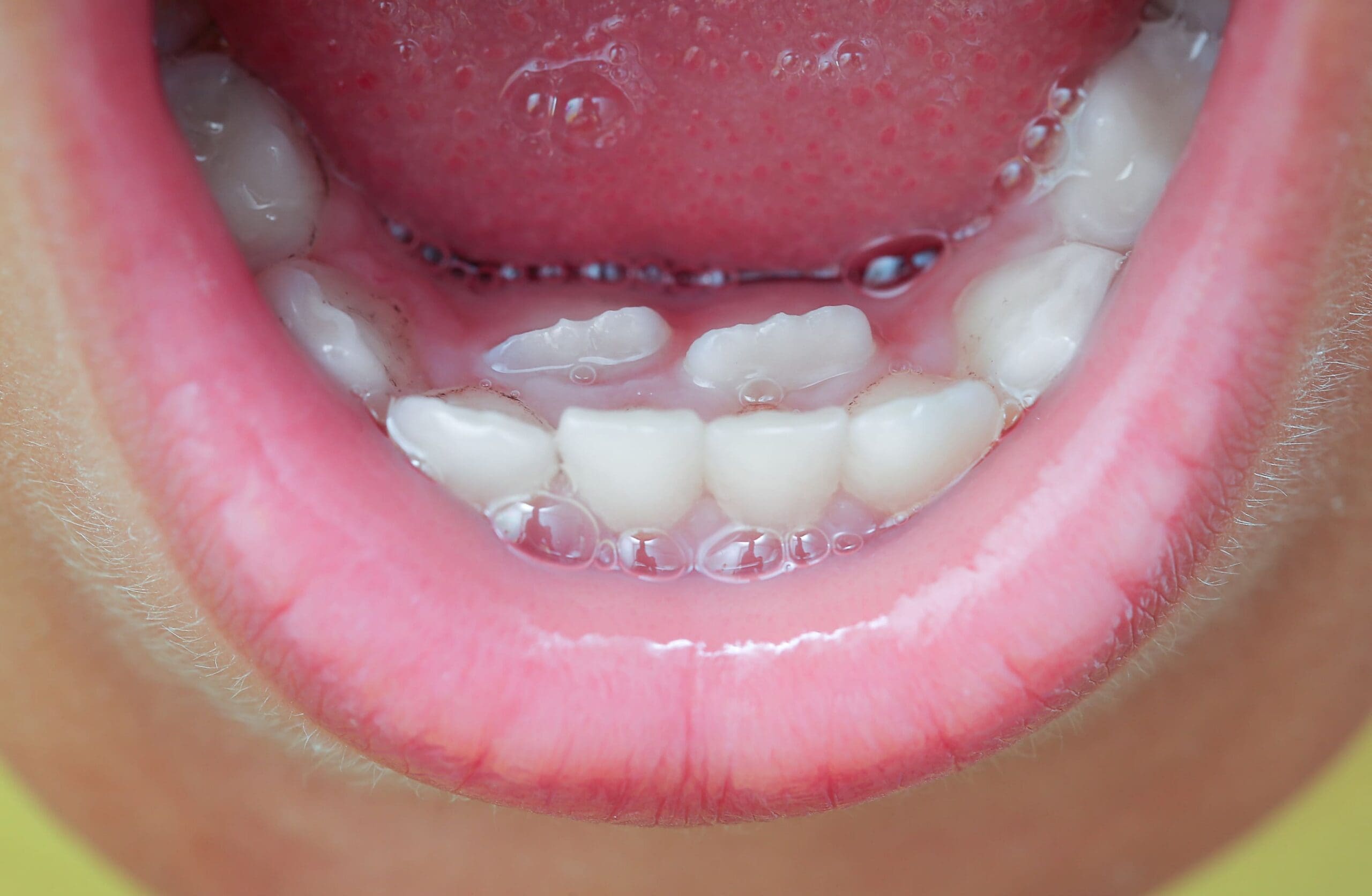
“Shark teeth” is the nickname for an adult tooth that has erupted (come through the gum) behind a baby tooth that has not fallen out yet. The result is a temporary double row of teeth. It gets its name because sharks grow rows of teeth stacked behind one another, and for a few weeks your child’s mouth looks a little like that.
It looks more dramatic than it is. What you are seeing is a timing overlap, not a defect. The new adult tooth simply arrived before the baby tooth got out of the way.
Shark teeth show up most often with the lower front teeth, usually around ages 5 to 8 when the first adult teeth start coming in. You can also see it with the upper front teeth, and sometimes with the back molars a bit later, closer to ages 10 to 13. If your child is in one of those windows, a double row is a fairly ordinary sight.
Why do adult teeth sometimes come in behind baby teeth?
Adult teeth come in behind baby teeth when the erupting adult tooth does not press directly on the root of the baby tooth above it. Normally, an incoming adult tooth dissolves that root as it pushes up, which loosens the baby tooth until it falls out. When the adult tooth erupts at a slight angle or behind the baby tooth, that pressure misses the mark and the baby tooth stays put.
So the baby tooth is not being stubborn on purpose. Its root simply has not dissolved as quickly because the tooth underneath came in from a slightly different spot.
This is a positioning and timing quirk, not a sign your child did anything wrong or has a serious problem. It tends to run in families, so if you or a sibling had a double row of teeth as a kid, you may see it again. For some children, this is just how their teeth come in.
Do shark teeth fix themselves?
Most of the time, yes. As the adult tooth continues to push up, it keeps working on the baby tooth’s root, and within a few weeks the baby tooth usually loosens and comes out. The tongue then does a lot of quiet work, gently nudging the new adult tooth forward into its proper spot over the following weeks.
A few things help the process along:
- Encourage your child to wiggle the loose baby tooth with clean hands, gently and often, without forcing it.
- Keep brushing the area normally so the gum stays healthy.
- Give it time. A few weeks to a couple of months is a reasonable window before assuming anything needs to be done.
In plenty of cases, the whole thing plays out before your next scheduled checkup, and the double row is a memory by then.
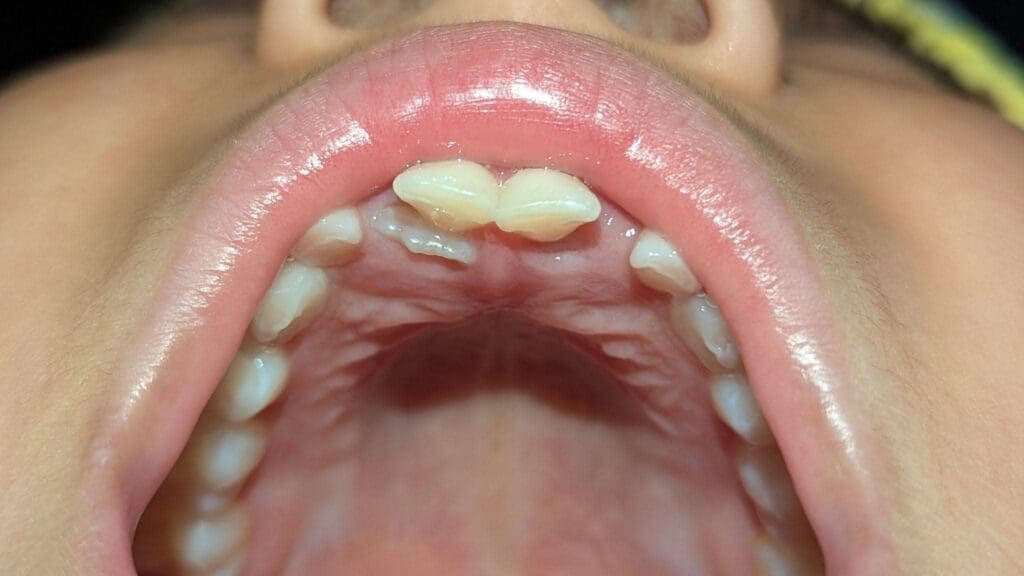
Before:
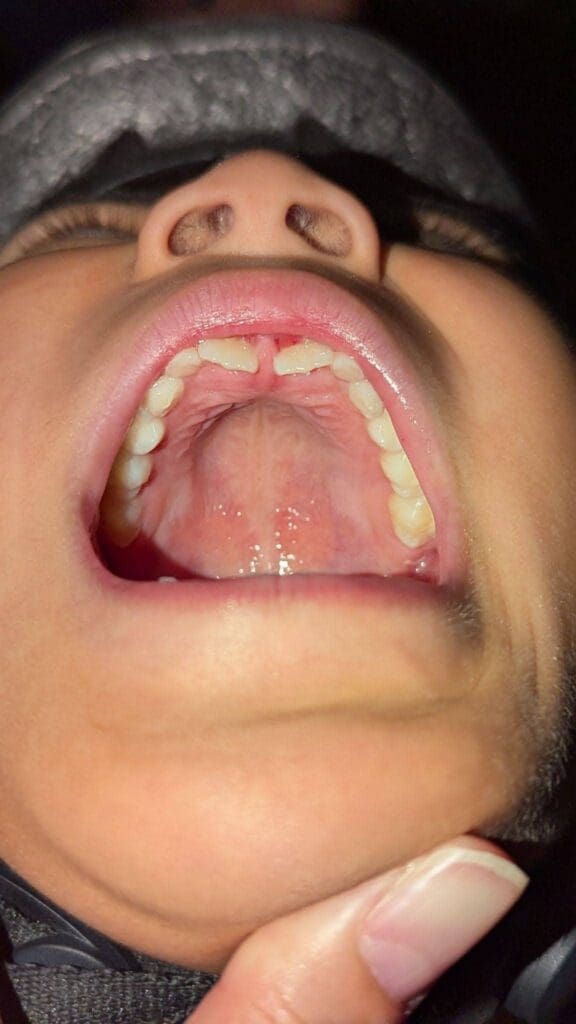
After:
Not sure whether your child’s shark teeth need a closer look? Schedule a consultation, book online or call any of our four Greater Toronto Area locations in Richmond Hill, Markham, Stouffville, and Hillcrest, and one of our pediatric specialists will check it out.
When should you see a pediatric dentist about shark teeth?
Book an assessment if the baby tooth is still firmly in place after about 1 to 2 months, the adult tooth is fully erupting behind it, there is pain or swelling, or the baby tooth is not loosening at all. Also book if the adult tooth looks like it is being crowded noticeably out of line.
Here are the concrete signals worth acting on:
- The baby tooth stays firm and shows no signs of loosening after two to three months.
- The adult tooth is coming in fully while the baby tooth holds its ground.
- There is pain, tenderness, or swelling around the area.
- The new tooth is being pushed well out of alignment.
A visit is straightforward. One of our pediatric specialists checks whether the baby tooth’s root has already dissolved, and sometimes a quick X-ray helps confirm what is happening below the gum. If the baby tooth is stuck and not going anywhere on its own, a simple, gentle extraction (removing the stuck baby tooth) clears the path so the adult tooth can settle in. (Baby teeth still do an important job holding space for adult teeth, which is why we only remove one when it is genuinely stuck.) We keep the visit calm and stress-free for your child, and because we accept CDCP and bill most insurance directly, you will know your coverage before the appointment rather than paying upfront and chasing it later.
One caution: it is hard to tell from home whether a root has dissolved. Rather than self-diagnosing, let a pediatric dentist confirm what is going on so you are working from facts, not guesswork.
Curious whether your child’s overall dental habits are on track while you are here? Our 90-second smile quiz is a quick way to spot anything else worth a mention at your next visit.
Do shark teeth mean your child will need braces?
Usually not on their own. Shark teeth by themselves do not cause long-term crowding or guarantee future orthodontic treatment. Once the baby tooth is out of the way, the adult tooth often drifts into its proper position naturally, helped along by the tongue and the surrounding teeth.
That said, the moment your child’s adult teeth start arriving is exactly the moment worth paying attention to how they are coming in, and this is where our approach differs from a general dental office. Shark teeth are a natural checkpoint for an early orthodontic evaluation, which is about monitoring, not prediction. There is a reason the recommended age for a first orthodontic check is around age 7: watching how the teeth erupt gives a specialist an early read on whether anything might need gentle guiding later, and on the early signs that point to treatment.
We will not promise you a specific outcome, because every child’s teeth develop differently. What we can tell you is that if follow-up ever is needed, our pediatric and orthodontic specialists work under one roof, so the transition from a first checkup to any orthodontic care happens with the same team who already know your child, with no referral out to a stranger and no starting over.
What can you do at home right now?
A short, practical checklist if you have just spotted a double row of teeth:
- Encourage soft, regular wiggling of the loose baby tooth with clean hands.
- Keep the area clean and keep brushing gently around both rows of teeth.
- If it feels appropriate for your child, offer crunchy foods like apple slices, which can help nudge a loose baby tooth along.
- Keep an eye on progress over the next few weeks.
And a few things to skip:
- Do not pull the tooth hard or twist it. Forcing it can hurt and is not necessary.
- Do not panic. This is common and usually temporary.
- Do not ignore it for many months. If nothing is changing, that is your cue to book.
Shark teeth are usually painless, so ongoing pain is a real reason to call rather than wait. And if your child is already keeping up with regular dental checkups, a specialist is likely watching for this kind of thing anyway, which takes some of the pressure off you to judge it alone. (Wondering about the loose baby tooth itself? Here is our guide to what to do about your child’s wiggly tooth.)
Frequently asked questions
Are shark teeth in kids normal?
Yes. It is common for an adult tooth to erupt behind a baby tooth, especially with the lower front teeth around ages 5 to 8. In most cases the baby tooth loosens and falls out on its own within a few weeks, and the adult tooth moves into place.
Should I pull my child’s baby tooth if the adult tooth is behind it?
Do not force it. You can encourage your child to gently wiggle a loose baby tooth with clean hands, but if it is still firmly in place after a couple of months or the adult tooth is fully coming in, book a visit so a pediatric dentist can check whether a quick, gentle extraction is needed.
Will shark teeth cause my child to need braces?
Usually not on their own. Once the baby tooth is out of the way, the adult tooth often drifts into position naturally. Shark teeth can be a good moment to keep an eye on how the adult teeth are coming in, which is part of an early orthodontic evaluation around age 8.
How long should I wait before seeing a dentist about shark teeth?
If the baby tooth has not loosened or fallen out within about 1 to 2 months while the adult tooth keeps erupting, or if there is pain, swelling, or a tooth pushed noticeably out of line, it is worth booking an assessment.
Do shark teeth hurt?
They are usually painless. If your child has ongoing pain, tenderness, or swelling around the area, that is a reason to call a pediatric dentist rather than wait it out.